Purpose
This guide will help you and your family understand how to choose the right DBS implant system for your needs. The final choice depends on your medical condition, lifestyle, and personal preferences, in consultation with your functional neurosurgeon.
1. Understanding the DBS System
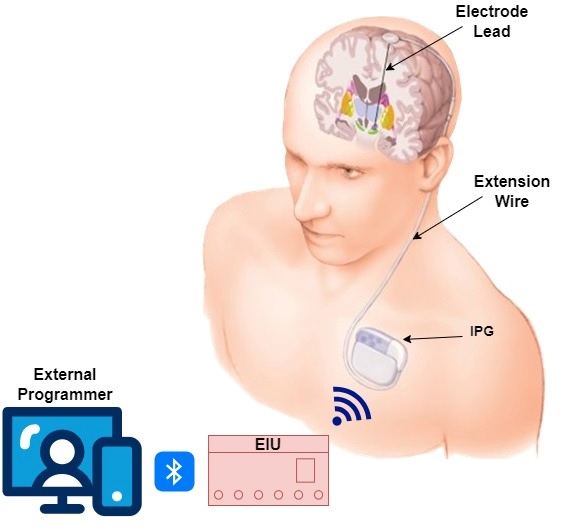
A DBS system has three main parts:
- Leads (electrodes): Thin wires placed in specific brain areas to deliver gentle electrical stimulation.
- IPG (Implantable Pulse Generator): The battery and controller, placed below the collarbone (similar to a pacemaker).
- Remote control device (External Programmer): This portable device helps you to adjust the current or change the programs in consultation with your surgeon without visiting his clinic through teleconsultation which can save a lot of time.
💡 Dr. Baldia’s Tips:
- Cranial electrodes are implanted only once in the brain and are meant to stay lifelong. Hence, it’s worth choosing the best and most reliable option available.
- Patients who do not have easy access to the DBS programming doctor should always consider taking the remote for time to time adjustments in the settings.
- Also discuss if there are additional charges for programming after DBS surgery or the cost is included in the surgery. If you have remote, you need not visit the doctor for minor adjustments, it can be done through teleconsultation.
2. Factors to Consider When Choosing Your DBS System
1. Type of Battery (IPG)
| Type | Description | Advantages | Points to Consider |
|---|---|---|---|
| Rechargeable | You recharge it once every 2–3 weeks using a small wireless charger at home. |
|
|
| Non-Rechargeable | Works for 3–5 years depending on settings, then replaced with a short surgery. |
|
|
💡 Dr. Baldia’s Tips:
- Based upon the financial sponsoring body (insurance, CSR, or self-funded), you can decide between rechargeable and non-rechargeable options.
- People who are self-funding should know that the replacement of the IPG (pacemaker) would cost you 80% of the current cost of the surgery.
- An additional advantage with a non-rechargeable system is that after 5 years, you can upgrade to the latest technology available — you are not tied to the older generation system.
2. Lead (Electrode) Type
Standard leads: Effective for most patients.
Directional (segmented) leads: Allow more precise control of stimulation and may reduce side effects.
Your neurosurgeon will help to select the lead best suited to your brain target and symptoms.
3. MRI Compatibility
Ensure your DBS system is MRI-compatible, especially for 3 Tesla (3T) MRI scanners.
Some systems allow MRI of the brain and other body parts safely under specific conditions.
💡 Dr. Baldia’s Tips:
Checking MRI compatibility is extremely important. Many patients are over 60 years of age and may need high-definition 3T MRI scans for other health issues in the future. Hence please check the compatibility is for 1.5 T or 3T?
Ask your doctor:
Will my implant allow future MRI scans (3 Tesla)?
What steps are needed before getting an MRI?
4. Advanced Technologies (Adaptive DBS & Brain Sensing)
Some of the latest DBS systems offer:
Adaptive DBS: Automatically adjusts stimulation based on your brain activity.
Brain sensing: Records brain signals to fine-tune therapy over time.
💡 Dr. Baldia’s Tips:
These are exciting technologies that may improve long-term outcomes, but they come with additional costs. Discuss with your doctor whether their benefits justify the investment for your condition
5. Lifestyle and Convenience
Can you or your caregiver manage regular charging?
Are you comfortable using a small handheld programmer or charger?
Do you travel often (and need multi-country charger compatibility)?
Do you prefer “set-and-forget” (non-rechargeable) or “long-lasting with maintenance” (rechargeable)?
6. Cost and Warranty
Different companies offer various cost options and warranty durations.
Ask for:
Initial and future replacement costs
Battery warranty coverage
Availability of technical service support in your hometown
Additional programming cost
– By Dr Manish Baldia
Functional Neurosurgeon
Parkinson’s and Movement disorders Specialist


